
Picture a factory that makes every steroid hormone in your body: testosterone, estrogen, cortisol, progesterone, the lot. Pregnenolone is the raw material sitting on the loading dock before any of that gets built. That single fact, that it sits “upstream” of everything, is the whole reason people call it the “mother hormone.” It’s also the reason a lot of supplement marketing gets away with promising more than it can prove.
I want to walk you through this the way I’d want a friend to walk me through it: what the stuff actually is, what happens once it’s in you, what the research says (and doesn’t), and how to think about trying it if you’re still curious after all that.
One thing up front: pregnenolone shows up two ways, as a cheap over-the-counter capsule and as a compounded prescription made by a pharmacy. Neither version has the kind of large, rock-solid research behind it that would let anyone hand you a guarantee. Treat this page as background reading, then bring your actual questions to a clinician who knows your health history.
So what is this stuff, really?
Your body builds pregnenolone from cholesterol, mostly in the adrenal glands, and from there it branches out to become progesterone, DHEA, cortisol, testosterone, estrogen, and a few brain-active compounds called neurosteroids. Think of it like flour in a bakery. Flour can become bread, cake, or pasta, depending on which recipe the kitchen decides to run that day. Pregnenolone is the flour. Your body’s enzymes and feedback systems are the recipes.
That’s where the marketing quietly oversells things. “It’s the precursor to everything” is true as a description of the wiring diagram. It is not a promise that eating more flour gets you more cake. Your hormone system runs on feedback loops, the way a thermostat cuts the furnace off once the room is warm enough. Dump extra pregnenolone into that system and your body doesn’t necessarily decide to make more testosterone or more of whatever you were hoping for. It might just leave the extra raw material sitting there, or route it somewhere you didn’t expect.
Pregnenolone does have one job that’s genuinely its own, separate from being raw material. It and the substances it turns into act directly on brain receptors, including ones called NMDA and GABA-A receptors, the same general neighborhoods involved in mood, alertness, and anxiety. That direct brain activity, not the “precursor to everything” story, is the actual reason serious researchers have bothered studying it at all.
What the actual human studies show (slow down and read this part)
This is the section most product pages skip past, so let’s not skip it. The honest summary: human research on pregnenolone is thin, mostly small, mostly short, and mostly done in people with psychiatric diagnoses, not in healthy adults chasing more energy or a clearer head. Nobody has run a big, long-term study showing it improves energy, memory, or healthy aging in the general population, which happens to be exactly who buys it off the shelf.
Here’s what does exist, trial by trial.
A Duke University pilot study put 21 people with schizophrenia or schizoaffective disorder, all already stable on their antipsychotic medication, on either pregnenolone (raised up to 500 mg a day) or a placebo, for eight weeks. The pregnenolone group improved more on negative symptoms (a category that includes things like flattened emotion and low motivation), with scores moving 10.38 points versus 2.33 for placebo, a difference the researchers flagged as statistically meaningful (p=0.048). But on the main cognitive tests, the two groups came out about even [P1]. Translation: a real signal for one kind of symptom, no clear win for thinking skills, in a study the authors themselves described as a first step, not a verdict.
A bigger trial zeroed in on cognition specifically. Sixty people with recently diagnosed schizophrenia took either 50 mg of pregnenolone a day or a placebo, alongside their regular antipsychotics, for eight weeks. This time pregnenolone meaningfully improved visual attention compared to placebo (p=0.002, with a moderate-size effect) [P2]. Notice that dose: 50 mg, a tenth of what the Duke trial used, and it worked on a different outcome.
Then things get genuinely messy, which I think is the most honest part of this whole story. A third eight-week trial compared a low dose (30 mg/day), a higher dose (200 mg/day), DHEA, and a placebo across 58 people with longer-term schizophrenia. The 30 mg group improved on positive symptoms, attention, and working memory. The 200 mg group looked no different from placebo [P3]. Read that twice: less medicine worked, more medicine didn’t, in the same kind of trial. Combine that with a Duke study running participants up to 500 mg, and you’ve got a research field that hasn’t even settled the most basic starting question, how much should anyone take.
On mood, there’s one trial worth your attention. Eighty adults with bipolar depression got either pregnenolone (built up to 500 mg/day) or placebo, added on top of their usual treatment, for 12 weeks. Depression scores improved more over time in the pregnenolone group (p=0.025), and more people reached remission on pregnenolone than on placebo (61% versus 37%, p=0.046). Side effects were mild [P4]. The researchers called it promising and said it needs more study, which is exactly the right amount of confidence to borrow.
Add it up and here’s what it means if you’re not in a psychiatric trial and just want to feel less foggy: a handful of small-to-medium studies, in people with specific diagnoses, using pregnenolone as an add-on to other treatment, with results that don’t even agree on dose. Nothing here resembles proof that pregnenolone fixes fatigue or brain fog in an otherwise healthy person. Anyone telling you otherwise is stretching the data past its breaking point.
The dosing puzzle nobody’s solved
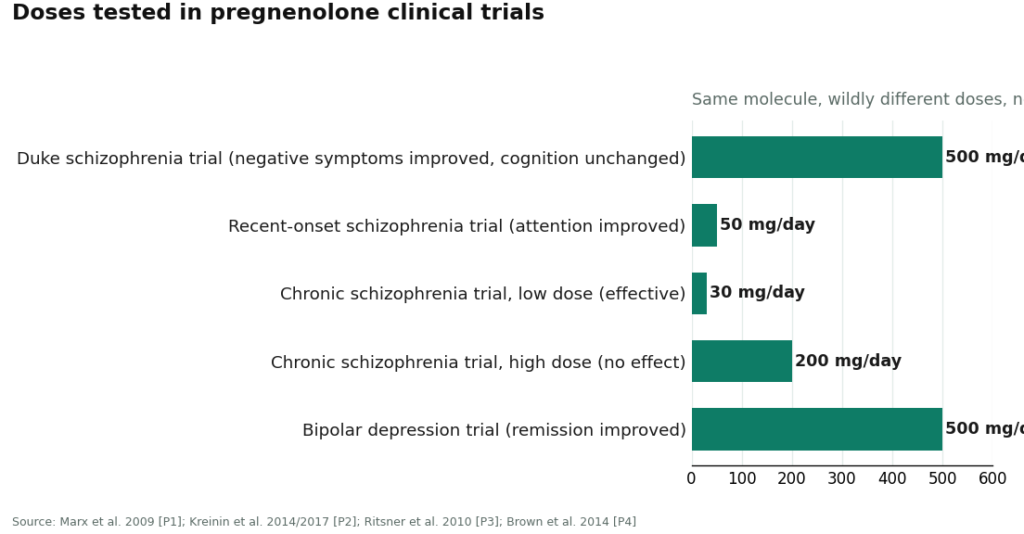
You can already see the problem laid out above: 30 mg, 50 mg, 200 mg, 500 mg, tested in different trials, on different outcomes, without a consistent pattern of “more is better.” Over-the-counter capsules typically land somewhere between 10 mg and 100 mg, numbers that have nothing to do with any of those trial doses. There simply is no evidence-backed “right” dose for energy, mood, or anti-aging use, because nobody has tested pregnenolone for those uses at any dose. That gap is exactly why guessing alone is a bad idea, and why having a prescriber pick a starting point and adjust based on how you respond is worth more here than it might be for a better-studied supplement.
What you’re actually paying for
Pregnenolone comes in two very different price brackets, and the gap between them tells you something.
The over-the-counter bottle is cheap, usually $10 to $25. For that price, you get the molecule itself and nothing wrapped around it: no one checking whether it’s a good idea for you, no guaranteed pharmacy-grade quality control, and the well-known problem of supplement potency not always matching what the label claims. You’re the entire quality assurance department, whether you signed up for that job or not.
The compounded-prescription route, arranged through a supervised telehealth provider, generally runs somewhere in the $30 to $90 a month range depending on dose and formulation. That extra cost isn’t buying a stronger or more special version of the molecule. It’s buying a physician’s judgment call about whether it fits your situation, and a licensed pharmacy actually making it to a consistent standard. For something this lightly studied, where even the right dose is an open question, that oversight is arguably most of what you’re paying for.
If you’re still curious, here’s the sensible way to go about it
Say you’ve read all of that and you still want to try it. The smart version of “trying it” isn’t ordering a bottle and hoping. It looks more like: a licensed clinician deciding whether it’s reasonable for you and at what starting dose, a licensed pharmacy actually preparing it, and someone checking back in to see whether anything changed. FormBlends is one telehealth outfit built around that chain: a physician reviews whether it makes sense for you, a licensed 503A compounding pharmacy prepares the prescription to USP standards, and the messaging stays upfront about how thin the evidence is instead of promising a fix. It’s mentioned here as one supervised path to access this, not as a ranked “best pick” and not as your only option.
Now the part that has to stay in plain sight: compounded pregnenolone is not an FDA-approved drug. The FDA has not reviewed it for safety, effectiveness, or quality, and the agency’s official position treats it as an unapproved new drug. The FDA also actively goes after supplement sellers who cross the line into claiming their products treat conditions like depression, and has sent warning letters over exactly that [P5]. A supervised setup doesn’t erase that caveat. It adds a layer of judgment and quality control on top of it, which is a different thing.
One more note if you compete in sports. Pregnenolone isn’t currently on the World Anti-Doping Agency’s banned list, but the U.S. Anti-Doping Agency still classifies it as a hormone-precursor pro-hormone, and warns that using any supplement in that category means accepting the general risks of an unregulated supplement industry, plus the fact that a substance’s banned status can change without much warning [P6]. “Not banned today” isn’t the same as “safe forever” or “will never be banned.” Check the current status yourself if it matters for your sport.
The bottom line, no sugarcoating
Pregnenolone is a real, biologically important molecule with a genuinely interesting job in your body. The human research behind it is thin, scattered mostly across psychiatric studies, and doesn’t back up the energy, memory, or anti-aging pitch you’ll see in most marketing. If that’s why you were considering it, the honest answer is that the evidence doesn’t support you spending the money, at least not for those reasons. If there’s a specific, real reason your clinician thinks it’s worth a shot, do it through a supervised path rather than a random capsule with nobody checking your work. The cheapest, fastest option here is usually the riskiest one, not because the molecule is dangerous, but because nobody’s watching to see if it’s actually helping.
Questions people actually ask
Will pregnenolone give me more energy or a sharper memory?
There’s no solid human evidence for that in healthy people. What research exists is small, short, done in people with psychiatric conditions, and even those results are mixed [P1][P2][P3][P4]. Nothing here supports the energy-and-vitality pitch you’ll see online. File that under unproven until better evidence shows up.
Does it raise testosterone?
Not in any clean, predictable way. Pregnenolone sits upstream of testosterone in the hormone pathway, but your body’s feedback loops and tissue-specific enzymes decide what actually gets built downstream. Taking more raw material doesn’t reliably push testosterone (or anything else specific) higher. The “precursor to everything” framing oversells what actually happens when you flood the top of the chain.
What dose should I use?
There isn’t an established, evidence-backed dose for energy or anti-aging use, because no trial has actually tested pregnenolone for those purposes. The clinical trials that do exist used anywhere from 30 mg to 500 mg, with results that didn’t move in a consistent direction [P3]. That inconsistency alone is a good reason to loop in a clinician instead of guessing.
Is the cheap drugstore version okay to just try?
You can buy it, but you’re taking on all the risk yourself: no one checking suitability, no guarantee of pharmacy-grade quality control, known inconsistency in supplement potency, and a product the FDA treats as an unapproved new drug [P5]. The low price gets you the molecule and nothing else.
Has the FDA approved pregnenolone?
No. There’s no FDA-approved pregnenolone drug for any condition, and the agency’s stance is that it’s an unapproved new drug [P5]. It’s legal to sell as a supplement, but being easy to buy off a shelf isn’t the same thing as being approved or proven to work.
Where does pregnenolone actually come from in the body?
Your body makes pregnenolone naturally, mostly in the adrenal glands, starting from cholesterol. It sits at the very top of the hormone production chain, meaning your body can convert it into progesterone, DHEA, cortisol, and eventually estrogen or testosterone. Levels tend to fall as you get older, which is part of why the supplement attracts interest, though a lower level doesn’t automatically mean adding more will fix whatever’s downstream.
What side effects should I actually watch for?
The most commonly reported ones are headaches, irritability, acne, and disrupted sleep, especially at higher doses. Because pregnenolone can tip toward either calming or stimulating brain chemicals depending on the person, mood shifts in either direction are possible. There are also theoretical concerns about it feeding into estrogen or cortisol pathways if you already have issues there. Most of what we know about side effects comes from anecdotal reports rather than large controlled trials, so the picture is incomplete.
Could it make me gain weight?
There’s no solid evidence that pregnenolone directly causes weight gain. Some people report water retention or appetite changes, but that’s informal, not something shown in controlled studies. Since pregnenolone can influence cortisol and other metabolism-related hormones, an indirect effect is plausible in theory. If you notice real weight changes after starting it, bring that up with a clinician rather than assuming the supplement is automatically to blame.
What do people actually use it for, and does the evidence back any of it up?
People reach for pregnenolone hoping to improve memory, mood, stress resilience, or general hormone balance, and some clinicians prescribe compounded versions, through pharmacies like FormBlends, for specific hormone-related concerns under supervision. The honest picture: early animal studies looked promising for cognition, but the human trials since then have been small and their results mixed. No single use has strong enough evidence yet to call it proven. That gap between online enthusiasm and what the studies actually show is worth keeping in your back pocket before you spend money on it.
References
- Marx CE et al. Proof-of-concept trial with the neurosteroid pregnenolone targeting cognitive and negative symptoms in schizophrenia. Neuropsychopharmacology, 2009. n=21 randomized; pregnenolone to 500 mg/day improved negative symptoms (SANS change 10.38 vs 2.33, p=0.048) but not the primary cognitive composites. https://pubmed.ncbi.nlm.nih.gov/19339966/
- Kreinin A, Bawakny N, Ritsner MS. Adjunctive pregnenolone ameliorates the cognitive deficits in recent-onset schizophrenia: an 8-week, randomized, double-blind, placebo-controlled trial. Clinical Schizophrenia & Related Psychoses, 2017 (epub 2014). n=60; adjunctive pregnenolone 50 mg/day reduced visual-attention deficits versus placebo (p=0.002, d=0.42). https://pubmed.ncbi.nlm.nih.gov/24496044/
- Ritsner MS et al. Pregnenolone and dehydroepiandrosterone as an adjunctive treatment in schizophrenia and schizoaffective disorder. Journal of Clinical Psychiatry, 2010. n=58; low-dose pregnenolone 30 mg/day improved positive symptoms, extrapyramidal side effects, and attention/working memory, while 200 mg/day did not differ from placebo.
- Brown ES et al. A randomized, double-blind, placebo-controlled trial of pregnenolone for bipolar depression. Neuropsychopharmacology, 2014. n=80; pregnenolone to 500 mg/day for 12 weeks produced a significant treatment-by-week improvement on the Hamilton Depression Rating Scale (p=0.025) and was well tolerated.
- U.S. Food and Drug Administration. FDA Sends Warning Letters to 10 Companies for Illegally Selling Dietary Supplements Claiming to Treat Depression and Mental Illness. Used here to support the general FDA enforcement and unapproved-new-drug framing, not as a page naming pregnenolone specifically.
- U.S. Anti-Doping Agency. Pregnenolone: What You Need to Know. Notes pregnenolone is a hormone-precursor pro-hormone, not currently on the WADA Prohibited List but its status can change, and warns of the inherent risks of the supplement and compounding industry.
Written by Zuri Eriksen, contributing writer. Grounding every claim in the sources linked here. Last reviewed June 2026.
Provided as general education. Your prescriber should sign off before you start a new regimen.